
5 Reasons Olympia WA Homeowners Should Clean Their Roof Before Moss Does Permanent Damage
In Olympia, Lacey, Tumwater, Centralia, and Chehalis, moss on a roof is not a question of if. It is a question of how much and how long.
The South Puget Sound climate delivers everything moss needs to establish and spread: consistent rainfall from October through May, high ambient humidity, heavy tree cover that limits sunlight to north-facing and shaded roof slopes, and temperatures that keep moss actively growing for most of the year. According to OSU Extension plant pathologist Jay Pscheidt, in the moist Pacific Northwest, moss on roofs is inevitable, and when it clings to shingles it can cause damage leading to costly repairs or replacements.
Champion Cleaning has been cleaning roofs across the South Puget Sound region for over 25 years. The roofs the team sees with the most damage are almost never the ones where moss appeared recently. They are the ones where moss appeared two or three seasons ago and the homeowner decided to deal with it later.
Later almost always costs more.
Why Olympia Roofs Face a Moss Problem Most of the Country Does Not
The Pacific Northwest creates conditions for moss growth that do not exist in most other regions. High frequency rainfall, limited direct sunlight under heavy tree canopy, and temperatures that stay in the moss-friendly range for the majority of the year produce a persistent biological challenge that homeowners in drier climates simply do not face.
According to
OSU Extension's SolvePest resource on roof moss, the most common mosses found on structures in the Pacific Northwest are Dicranoweisia cirrata and Bryum capillare. These are not occasional visitors. They are persistent colonizers that establish on shaded roof surfaces and spread continuously when conditions are not addressed.
| Local condition | Why it accelerates moss damage |
|---|---|
| Rainfall October through May | Keeps roof surfaces wet for extended periods with minimal dry time |
| Heavy tree canopy | Limits sunlight that would otherwise dry the roof surface between rain events |
| High ambient humidity | Even light moss growth remains damp for weeks without sun exposure |
| North-facing slopes | Receive the least direct sunlight, become primary moss establishment zones |
| Mild temperatures year-round | Moss grows actively across a wide temperature range throughout the Pacific Northwest |
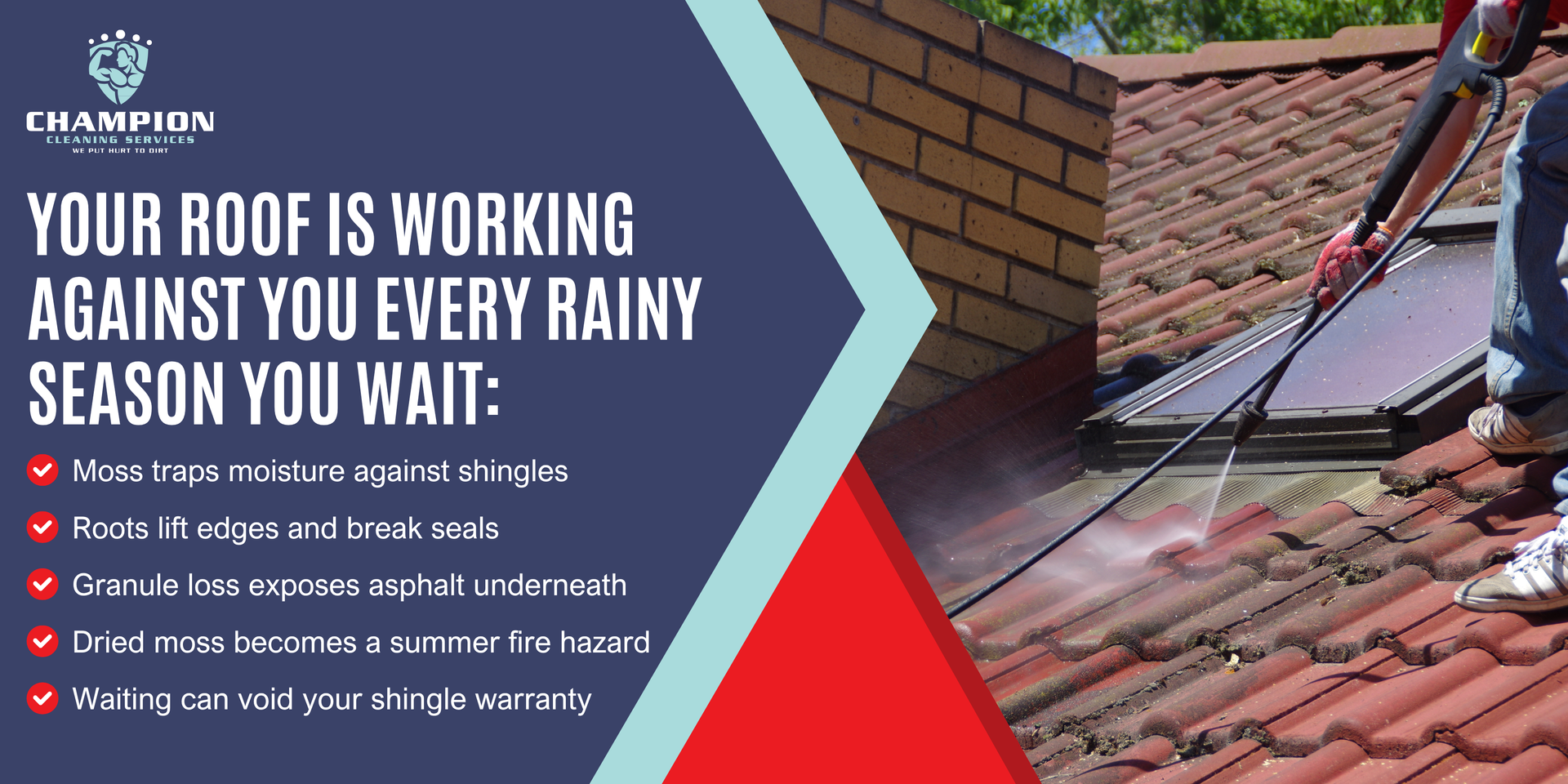
Reason 1: Moss Holds Moisture Against Shingles That Are Designed to Shed It
Asphalt shingles are designed to shed water. Rain falls, runs downward, and the shingle surface dries between events. That wetting and drying cycle is what asphalt shingles are built to manage across a 25 to 30-year lifespan.
Moss disrupts this cycle entirely. According to OSU Extension's Care and Maintenance of Wood Shingle and Shake Roofs, moss accumulates soil and debris on the roof, causing the surface to wet quickly and remain wet for longer periods, which encourages fungal growth and accelerates decomposition.
In Olympia's climate, where roofs rarely get extended dry periods between rain events, this sustained moisture contact is not a seasonal concern. It is a year-round pressure on the shingle material that compounds with every month moss is allowed to remain.
What sustained moisture against shingles does over time:
- Accelerates granule loss as the bonding between granules and asphalt beneath them degrades under persistent wet conditions
- Promotes wood rot, mold growth, and insulation damage in the roof assembly below
- Creates the conditions for interior ceiling stains that appear long after the moisture damage has already progressed
Reason 2: Moss Roots Lift Shingle Edges and Break Adhesive Seals
Moss does not simply grow on the surface of shingles. Its rhizoids, the root-like structures that anchor it, penetrate between shingle edges and into the shingle material itself. This creates a mechanical lifting force that works against the adhesive seal designed to hold shingle edges flat against the roof deck.
According to OSU Extension, moss growth slows or prevents water flow off the roof and contributes to shingle damage. As growth thickens, it wedges itself under shingle edges, lifts them, and breaks the adhesive seal that holds the shingle flat.
A lifted shingle edge that would perform adequately against vertical rainfall becomes an active water entry point under the wind-driven rain conditions common during South Puget Sound winter storms. Water that enters beneath a lifted shingle edge does not stay at the surface. It reaches the underlayment and roof deck below.
Champion Cleaning's team sees this pattern consistently in Olympia, Lacey, and Tumwater homes where moss has been present for two or more seasons: what starts as a surface appearance issue has become a moisture intrusion issue by the time the homeowner schedules a cleaning.
Reason 3: Moss Damage Can Void Your Shingle Manufacturer Warranty
Most asphalt shingle manufacturers include maintenance requirements as a condition of warranty coverage. Allowing moss to grow unchecked and allowing the associated moisture damage to progress typically falls under the manufacturer's exclusion for lack of maintenance.
A standard architectural shingle carries a 30-year limited warranty from the manufacturer. If moss damage accelerates shingle deterioration to the point of failure at year 18, and the roof has never been professionally cleaned, the warranty claim for premature failure may be denied. The homeowner who assumed the warranty protected them discovers it was contingent on maintenance they did not perform.
For Olympia-area homeowners, professional roof cleaning documented as part of a regular maintenance program is the most direct evidence that the maintenance condition of a shingle warranty has been honored. Champion Cleaning recommends scheduling roof cleaning before visible moss coverage becomes widespread, precisely because that timing keeps the maintenance record clean.
Reason 4: Dried Moss Is a Fire Hazard During South Puget Sound Summers
This is the consequence that surprises most Olympia homeowners, and it is documented directly by OSU Extension's SolvePest program: dried-out moss and debris on roofs is flammable.
During the South Puget Sound's dry summer months, typically July and August, the thick moss mats that accumulated over the wet season dry to a condition that can ignite from ember contact or radiant heat. While direct wildfire ember exposure is less common in urban Olympia than in rural areas of Thurston County, the fire risk from dried moss debris is not limited to wildfire proximity. Chimney sparks, fireworks, and other ignition sources can find a receptive fuel load in a dried moss mat in ways that a clean roof would not provide.
This risk is most relevant for homes with heavy moss accumulation heading into summer, which is precisely the homes that have deferred cleaning through multiple wet seasons.
Reason 5: Soft Wash Cleaning Removes Moss Without Damaging the Shingles
The method of roof cleaning matters as much as the timing, and the most common mistake homeowners make when addressing moss themselves is using pressure that damages the very shingles the cleaning was meant to protect.
According to OSU Extension's guidance on roof moss management, improper pressure washing can strip shingle granules and force water under shingles. The granule loss that pressure washing causes is the same process that moss itself accelerates, meaning an incorrect DIY cleaning approach compounds the damage rather than reversing it.
Soft wash cleaning vs pressure washing:
| Factor | Soft Wash | Pressure Washing |
|---|---|---|
| Application pressure | Low pressure, safe for shingles | High pressure can strip granules |
| Moss treatment | Kills moss at the biological root level | Removes surface growth, leaves root structure |
| Regrowth timeline | Significantly slower | Faster, roots survive and regrow |
| Granule impact | No granule loss | Risk of accelerated granule loss |
| Underlayment risk | No water forced under shingles | Water can be forced under shingle edges |
| Appropriate for | All asphalt shingle roofs | Not recommended for shingle roofs |
Soft wash is a low-pressure application of a cleaning solution that kills moss, algae, and biological growth at the root level. The solution is applied at pressures well below what asphalt shingles can tolerate and allowed to work, eliminating the biological growth before it is rinsed from the surface.
Champion Cleaning's soft wash process for Olympia, Lacey, Tumwater, Centralia, and Chehalis roofs accounts for the Pacific Northwest's specific moss species and the shingle types most common in South Puget Sound construction. A surface-level cleaning that leaves the rhizoid root structures in the shingle material will produce regrowth within one to two seasons. A properly executed soft wash eliminates the growth at its source and extends the clean interval significantly.
When Should an Olympia Homeowner Schedule Roof Cleaning?
| Situation | Recommendation |
|---|---|
| Light green haze visible on shaded slopes | Schedule cleaning this season |
| Visible moss patches on any roof slope | Schedule cleaning now |
| Thick moss coverage on multiple slopes | Schedule cleaning immediately, assess shingle condition |
| Roof not cleaned in more than 3 years | Schedule cleaning regardless of visible moss |
| Summer dry season approaching | Ideal timing for soft wash application |
| Shingle warranty active | Clean and document to maintain warranty conditions |
OSU Extension recommends cleaning before the fall rains in the Pacific Northwest as the ideal preventative timing. For Olympia homeowners, that means late summer, when conditions are dry and the cleaning solution can work most effectively, is the optimal window for annual or biennial roof maintenance.
Frequently Asked Questions
How often should an Olympia WA roof be cleaned?
In the South Puget Sound's climate, most roofs benefit from professional cleaning every one to three years depending on tree coverage, roof pitch, and shade exposure. North-facing slopes under heavy canopy may need more frequent attention than south-facing slopes with better sun exposure.
Can I clean moss off my roof myself?
Light surface moss on a single-story home in a safe, accessible location can be managed with appropriate low-pressure equipment and correct solution. Heavy moss coverage, two-story roofs, steep pitches, and any situation where walking on the roof creates a safety risk are jobs for professional equipment and trained crews. Pressure washing is not appropriate for asphalt shingles regardless of who operates it.
Does roof cleaning damage the shingles?
Properly executed soft wash cleaning does not damage shingles. Pressure washing at inappropriate settings or angles can strip granules and force water under shingle edges. This is why the cleaning method matters as much as the timing.
What is the difference between moss and algae on a roof?
Moss is a plant with rhizoid root structures that penetrate into shingle surfaces. Algae is a biological growth that stains the shingle surface but does not penetrate or lift shingles. According to OSU Extension, lichens look similar to mosses but unlike moss do not contribute to composite shingle damage. Moss is the primary structural concern on Olympia-area roofs.
Will moss come back after cleaning?
It will eventually return in Pacific Northwest conditions. The question is how quickly. A soft wash treatment that kills the biological growth at the root level produces a significantly longer clean interval than surface removal that leaves the root structures intact. Maintaining clear gutters and trimming overhanging branches that shade the roof, as recommended by OSU Extension, reduces the rate at which moss reestablishes.
Does Champion Cleaning service commercial properties in Olympia?
Yes. Champion Cleaning serves apartment communities, condominium associations, office buildings, and HOA properties throughout Olympia, Lacey, Tumwater, Centralia, and Chehalis with pressure washing, exterior cleaning, and property maintenance programs. Contact the team to discuss a customized cleaning program for your property.
Whether you manage a residential property or a professionally managed building in the South Puget Sound area, Champion Cleaning can build a cleaning program that keeps your exterior surfaces clean, protected, and maintained through every season.
Contact Champion Cleaning |
Roof Cleaning Services |
Pressure Washing |
Gutter Cleaning
Recent Posts
Ready to Refresh Your Home or Business in Olympia, WA?
Don’t wait another day to enjoy a cleaner, healthier, and more inviting space. At Champion Cleaning Services, we bring over 35 years of expertise, advanced techniques, and true family values to every job we take on. Whether you need carpets deep cleaned, your roof restored, or your windows sparkling, our Olympia cleaning team is here to deliver results you’ll love.